Reduce Call Volume with Patient Secure Texting
June 7, 2023
Reduce call volume and improve efficiency with patient secure texting. Studies show that the majority of Americans own smartphones and prefer mobile messages over emails or calls. Secure messaging platforms enable healthcare organizations to save time and improve patient care by answering FAQs, disseminating information, automating administrative tasks, and supporting population health initiatives.


SMS, or short message service commonly known as texting, is a fast, efficient, and convenient method of communication. Messages can be sent from virtually any location to mobile devices. Instant messaging solutions support the sending audio and video files, images, and other file attachments via text. Studies reveal text messaging has overwhelming support:
- More than 95% of Americans own a cell phone; every three in four have a smartphone.
- Approximately 90% of patients aged 50+ use personal technology to stay connected.
- Roughly 85% of smartphone users prefer mobile messages to emails or calls.
- Most people open a text within three minutes of receiving it, while 45% reply back to SMS messages.
- Roughly 90% of patients agreed that text updates help them avoid calling the office.
- Family members and loved ones feel that text messaging allows them to stay informed and that, in turn, reduces their anxiety.
In social settings, SMS is so pervasive that it sometimes replaces even face-to-face communications. It is commonplace to see people sitting directly across from each other, together but heads bowed and silent, their eyes and fingers scrolling down the screen of their smartphones, typing.
Secure Text Messaging Is Expanding Beyond Care Teams to Include Patients
In healthcare, HIPAA-compliant secure messaging is accepted as a standard in provider-to-provider communication, replacing outdated, insecure methods like phone calls, pagers, faxes and snail mail. This is welcome news as healthcare organizations need proven tools extended to patients to cope with an overburdened workforce due to an unprecedented labor shortage, archaic technology fails, and dropping patient perceptions of the care experience.
Secure messaging is also expected to improve healthcare delivery to an aging population, working to manage multiple chronic conditions. Older adults are disproportionately affected by chronic conditions, such as diabetes, arthritis, and heart disease. Nearly 95% have at least one chronic condition, and nearly 80% have two or more.

Healthcare and the tools used to interact with patients, e.g., secure messaging, are fast evolving beyond traditionally treating patients with single acute conditions to treating a growing number of patients with multiple chronic conditions.
The demand for patient text messaging to initiate, intervene and maintain healthcare behaviors and improve outcomes, coupled with the pandemic’s accelerated use of digitalization, makes one trend certain: Healthcare is on the fast track to becoming patient-centered, integrated, and personalized.
Choosing the Right Patient Messaging Platform
Selecting the best secure messaging platform depends on the needs of your practice or health system. Two types of messaging tools to build interactive provider-patient messaging experiences are:
Live person to live person: One of the oldest forms of telehealth, a HIPAA-compliant secure two-way messaging platform is the initial first step to allow providers and care team members to communicate easily and effectively with one another ─ live person to live person ─ in real time reducing the volume of phone calls. SMS messaging can also be extended to patient users to communicate with their providers between visits.
AI-digital assistant to person: As the organization’s healthcare communication evolves, a digital assistant or chatbot using advanced artificial intelligence (AI) can enable a more personalized, conversational experience. A robotic process automation (RPA) chatbot mimics the decision-making ability of a human healthcare professional when performing rule-based tasks, offloading routine, administrative tasks entirely.

3 Use Cases of Patient-provider Secure Messaging That Reduce Care Team Time Spent on the Phone
The following are three basic categories of secure messaging applications implemented by healthcare organizations:
1. Enable staff to patient secure texting
Secure messaging can dramatically reduce the amount of time that healthcare staff spend on nonstop telephone calls with providers, peers, patients or families of patients to increase efficiency and save time. Examples of how organizations can swap secure messaging for time-consuming, repetitive calls and telephone tag, and care coordination activities include:
- Answering a wide range of frequently asked questions (FAQs) that help proactively prevent additional questions. Common patient queries can be converted to quick messages to further reduce staff time.
- Disseminating information such as lab test results, patient education, or pre-op surgery instructions.
- Proactively updating families as patients move through procedural areas.
- Sending the after-visit care summary to reinforce discharge guidance, medication adherence, and communication with trusted care team members supporting the patient.
- Connecting with in-network providers when referred. For instance, an interventional cardiologist orders a surgical procedure for a patient and coordinates the handoff to an in-network cardiac surgeon. The conversation between the patient and cardiac surgeon starts with secure messaging.
- Asynchronously coordinating data needed for approval and administration of specialty medications. Patients can securely message their physician, health plan, hospital pharmacist or other entities for refill, reorder and tracking, billing payments, travel requests, and other drug-related needs.
2. Automate routine administrative tasks for patient self-management
Patients prefer to interact online at their convenience with their providers, whether working, traveling, or at home. Conversational AI chatbots are best used in this instance to automate the patient's distinct needs before, during, and after the visit, saving clinicians and staff precious time. Self-service options that empower patients include:
- Self-scheduling a virtual visit, testing their internet connection, and completing online forms prior to engaging with the clinician to maximize the provider’s time for actual patient care.
- Scheduling, modifying, or canceling appointments
- Completing pre-appointment or pre-procedure forms
- Scanning insurance cards and driver’s license
- Preparing for a visit
3. Leverage automation to support population health initiatives
Secure messaging that links to AI conversational chatbots supports the next frontier of proactive, personalized engagement. This is particularly beneficial to enable proactive outreach for preventive healthcare without the need to hire additional staff.
Since the Triple Aim is rooted in improving population health, preventive care messaging can fundamentally transform the approach to patient care prevention strategies increasing cholesterol testing, colonoscopies, pneumonia vaccinations, mammography exams, PAP smears, and prostate examinations, to name a few.
Two programs where high-touch electronic messaging can make a difference are:
- Preventive maintenance reminders. Hospitals and practices can identify and close gaps in care in high-risk and rising-risk populations and receive additional revenue for doing it successfully before the patient’s health deteriorates or an acute adverse event occurs.
- Readmission prevention outreach. Achievable through digital touch to all patients, this type of messaging automation escalates the sub-population needing reliable transportation or other resources to get to follow-up appointments, take their medications, and monitor and manage symptoms.
Providers Gain Benefits From HIPAA-secure Messaging
A secure, user-friendly messaging solution allows your hospital, health system, medical practice or healthcare organization to maximize efficiency and quality care, while concurrently realizing tangible benefits:
- Ensures workforce complies with HIPAA PHI security rules
- Supports work-life balance to foster a healthier way of life
- Increases work productivity
- Improves staff morale and satisfaction
- Achieves faster patient throughput and seamless transition
- Reduces administration costs
- Eliminates the need for manual processes
- Reduces dependencies on paperwork and phone calls
- Speeds patient intake and informed consent workflows
- Increases revenue through cost efficiencies
- Improves patient satisfaction and engagement (better Press Ganey scores)
- Reduces no-show rates
- Improves care quality, management and continuity
- Minimizes work disruptions
- Frees up time nurses’ time for higher priority items
- Allows staff to spend more quality time with patients
- Streamlines communication between providers and departments
- Enhance operational efficiencies
- Keeps patient wait times low and staff utilization optimal
Getting Started With HIPAA-secure Messaging
Here are five basic steps to jumpstart planning and pre-deployment activities when rolling out a secure messaging solution.
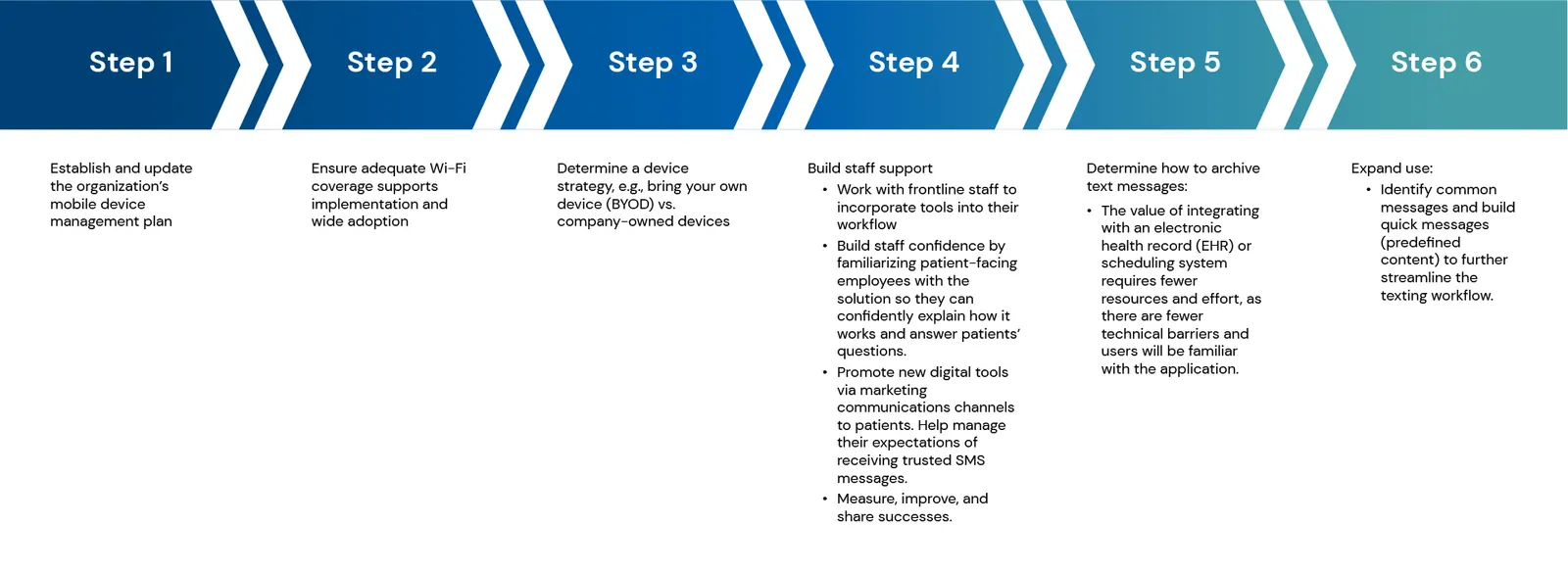
Embracing secure texting with patients is a win-win; it improves patient satisfaction and loyalty and staff satisfaction.